Tag Archives: Social Security Disability Insurance

A 2026 Example of Legislated Poverty

Hey followers, I know it’s been a while.

As you can imagine, the last six years have taken a lot out of me and a lot from me. I put everything I had into fighting COVID eugenics, and yet here we are in this prolonged ongoing pandemic in a worse place than we began.

I’m also currently reeling from the recent, huge loss of Alice Wong. I’m engulfed in grief about losing her, losing Tinu Abayomi-Paul last year, and losing so many other disabled community members in between.

I have many life updates for you all, but I can’t go there right now. I’m beyond capacity for going deep and I’m going to listen to my brain and body about that.

There’s no way to introduce the topic of this post other than diving right in.


The realities of living in legislated poverty are not widely discussed, so I write about them in various places and at various times to educate folks who have no idea.

You can read all of the general statistics, but it sometimes doesn’t make sense until someone tells you their own story, because that’s real. That’s tangible.

I’m writing this to share a single personal example about the intertwining of federal and state public aid systems that are designed to keep the poorest people poor, while those who write the legislation claim it helps people thrive.

Capitalist systems are designed to punish people who do not, cannot, produce profit.

I was granted SSDI in 2018. It’s hard to believe that was nearly eight years ago already. It’ll take another two years for me to have received enough SSDI to match the annual salary of the administrative law judge who approved my case.

Anyhow,

…towards the end of each year, the Social Security Administration announces the Cost of Living Adjustment (COLA) for people who receive Social Security benefits. The COLA for disability benefits recipients is a monthly increase that’s based on a comparison of the economy during the previous year’s third quarter and the current year’s third quarter.

Some years there’s no increase at all (2010, 2011, 2016). The highest ever increase was in 1980 (14.3%). The most recent “big” increase was in 2023 (8.7%).

This coming year, 2026, the increase is 2.8%. For me on SSDI, that is an additional $36/month.

Fortunately (hilariously), I’m poor enough that my Medicare premium is covered by California, but for many the COLA isn’t enough to cover the annual increase in Medicare premiums or it is mostly swallowed. 2025’s standard Medicare premium is $185/month. 2026’s is $202.90. That’s an increase of $17.90.

Let’s pretend for a moment that I needed to pay that increase; that means $17.90 taken out of my COLA of $36, which leaves me with $18.10/month “extra.”

Ok, let that sit for a moment.

Now, let’s shift to SNAP (formerly food stamps). Because of my SSDI increase, my monthly SNAP allotment has been automatically decreased by $16.

Remember, I had $18.10 left of my COLA after the example of me needing to cover the Medicare premium increase?

Now let’s subtract the $16 that was removed from my monthly SNAP amount, which overall leaves me with a $2.10 COLA. That’s enough for a candy bar each month, yay!

Except don’t forget the cost of food is ever increasing.

Ok, let all that sit for a moment.

And come back to my reality, which is less bad on a miniscule level.

Since I don’t have to cover the Medicare premium increase (or the premium at all, which makes me extremely lucky — imagine that, being lucky I’m that poor that the state covers it), I just have to remove the loss in food stamps ($16) from the COLA ($36), which leaves me with a $20 monthly increase in income for 2026.

My friends and I joke every year about what I could buy with my annual increase in riches, so that could cover, what, a half a tank of gas? Two or three dozen eggs? A pony!?

What do you spend $20/month on? What do you spend $20/day on?


Here’s a bonus, complicated tidbit for your anger:

Disability income (SSDI) is based on how much people made before becoming disabled. It’s not based on need. It’s not based on how disabled someone is. It’s not based on location. It’s based on capitalism’s perspective of how valuable a person is based on the profit they were producing before their body and/or mind could not produce that profit any longer.

And that means that SSDI income calculations parallel gender, race, class and age pay gaps, for example.


A final, important, and infuriating note: I’m far from the poorest SSDI recipient, so my increase is way more than many. And I haven’t even touched on how excruciatingly worse it is for SSI recipients.


That’s it for now, folks. Let me know how this info sits with you, and feel free to comment with your own experience.

Keep fighting, friends, and keep keeping community alive. OK?


If you’re curious to learn more about what I’ve shared, I urge you to do some reading about benefits cliffs; asset limits; and especially about disability marriage inequality (I highly recommend watching Patrice: The Movie!), which affects SSI recipients more than SSDI recipients, but it gets complicated when you add in Medicaid and SNAP and such regardless of the benefits source.

To the Social Security Administration About Denying My Claim for Disability Benefits

When I first wrote about applying for disability, I mentioned a standard practice of the Social Security Administration: default semi-automatic denials of disability claims. On average, it takes 3-5 years for someone who is disabled to be awarded benefits. This routine dragging out of claims affects me and many others financially and emotionally and also feels immoral and unjust. The disability process has been intentionally crafted to be as difficult as possible to navigate and even survive, yet this program was founded for the purpose of helping people live better lives.

The following letter is my formal response to a denial of my first claim. To be clear, many claims are denied twice before moving to a hearing with a judge. I am sharing this publicly because I want to expose the vulnerability so many go through as they seek disability – as they seek resources so they might live longer, healthier, fuller lives in the face of significant barriers to a substantial work-life.

Before I share my letter, here are some reasons I was told I am not disabled under the rules of the Social Security Administration:

Continue reading To the Social Security Administration About Denying My Claim for Disability Benefits

Applying for Disability Has Dehumanized Me

Applying for disability is a demeaning, humiliating, invasive process.

I’ve heard it could take as little as three months to be awarded federal disability benefits, but I would probably have to be literally dying. I’ve heard it’s possible it could take six months to a year. “It’s possible” in the world of bureaucracy is nothing to lean on. Most people trudge through two to five years of endless forms, initial decisions, appeals, reconsiderations, and hearings before becoming card-carrying members of the unofficial federal disability club – if they’re successful. In kind terms, the Social Security Administration (SSA) drags its feet more for those who are younger, more educated, and healthier-looking. The SSA is less likely to award disability to those who have worked recently or, ironically, to those who have worked fewer years. Additionally, the lesser known or more abstract the disability as well as the more physical (as opposed to mental), the less willing the SSA is to acknowledge a disability. These are facts I have been told by staff at my attorney’s office, and all but one of them apply to my case.

(here’s a link with some stuff that makes sense)


received_10156921444480347.jpeg
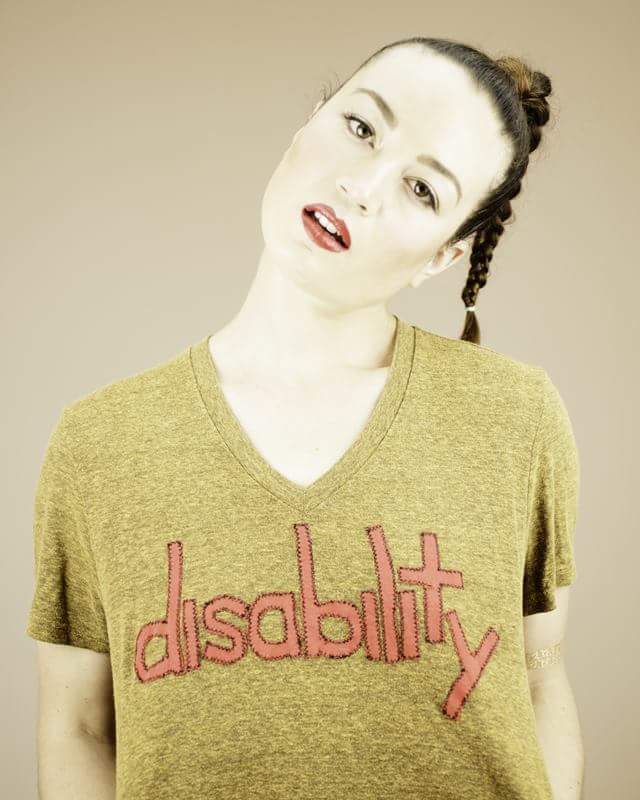
“I made this shirt.” Image by Rich Beckermeyer; Makeup by Alex Cassie

As if I hadn’t already made the most difficult decision of my life to accept my inability to work, applying for disability takes it one step further, forcing me to accept every single other thing I can no longer do, even those I am not ready to accept. I still have dreams of being healthy, so please don’t take what’s left away from me too.

My reality has been muted by the towering, sound-proof piles of paperwork that sprout legs and chase me while I toss and turn at night. I have to prove to the Social Security Administration that I am unable to work, but also that I can no longer function independently. I have to prove I no longer have a life despite all I have done to maintain a semblance of living. I feel I am on the middle school debate team and I’ve been assigned the side I don’t agree with; in order to win I have to admit that I am incapable of the freedoms I embraced in yesteryears. I have to do more than just admit them – I have to fully believe my inabilities enough to prove them true to strangers. I have to believe I’m less than I ever imagined I would be so that others will believe me too.

The piles of paperwork litter my kitchen table as I struggle to answer questions about my (in)ability to interact with people, go outside, take care of my health, and accomplish chores. Continue reading Applying for Disability Has Dehumanized Me

To the stranger who told me I’m not disabled

Most of the time, when people ask for help, they really need it.

Friends at the 2015 Sacramento Arthritis Foundation Walk to Cure Arthritis
Friends at the 2015 Sacramento Arthritis Foundation Walk to Cure Arthritis. Left to right: Cyd, Mel, Charis, Denice, Lori

And many of us are scared to ask because we’re afraid we’ll be attacked for it. A good friend recently put a crowdfunding page together in an effort to help me resist homelessness and survive the winter while I seek Social Security Disability Insurance (SSDI). Today, another friend shared the YouCaring link (edit 2/10/16: link no longer live) on her facebook page in support of me.

What happened next shocked me. Someone commented on my friend’s post about the youcaring campaign to help me. And it wasn’t supportive.

It was along the lines of, “When I am hurting I still get up and go to work. Your friend should find a job, she can work.”

I engaged in conversation with this person over several hours and took screenshots of the whole interaction, knowing the person might later delete her comments (which she did).

My effort was to see her side of the story – and in the end it came out that she had lost a child years ago and she was projecting her grief onto me in the form of hatred and judgment.  It was very sad and all I could do was continue repeating that I would be happy to talk with her in person so she could learn more about ankylosing spondylitis.

Those of us struggling to live with our chronic diagnoses are so often put into positions where we are challenged for our disabilities and forced to prove how sick we are. How degrading.
Continue reading To the stranger who told me I’m not disabled