On April 11th, 2013, I walked into my first appointment with a Rheumatologist and walked out with a diagnosis of Ankylosing Spondylitis and the beginning of a life of advocacy, both for myself and for so many suffering silently with this progressive, degenerative, extremely painful disease.
I was always a strong person, yet I am stronger now than I ever was before, but in ways I don’t want to be. I would much rather have the freedom to choose to be mediocre if it meant I could have my health.
We do not choose to be strong. We become strong when we choose to survive.
April is Spondylitis Awareness Month. Learn about Ankylosing Spondylitis by watching this video created by the Spondylitis Association of America. Then share it.
On April 14, 2015, I was reeling after a week of severe psychological episodes that included a trip to the Emergency Room. I was referred to a group day program that I walked out of because it was not what I needed. An awkward visit to a very clinical psychiatrist began my medication journey – I walked out of Rite Aid with two new prescriptions and new additions to my medical chart. I could no longer take care of myself without medication to help treat severe trauma and depression triggered by recent events. I had officially become mentally ill. I walked home shaking my pill bottles like maracas and finally felt there was help for me, then wrote these thoughts:
I know what it’s like to call out and have no one truly hear me
For the pain flooding my brain
I know the brokenness of a body grieving
The flashbacks of a mind recalling trauma
I also know what it’s like to finally be heard
And the help that comes
Sometimes too late
And never too soon
And the final, often fleeting, feeling of safety
One year later I am finally with a psychiatrist I trust, who provides what I need: one-on-one counseling in addition to superb medication management.
I have Severe Major Depressive Disorder and Post Traumatic Stress Disorder. I do not bow to stigma and I am not ashamed. There is no doubt in my mind that I need medication to help me process trauma and grief on a level playing field with my brain. I am not suicidal and never have been, but one doesn’t need to be suicidal to get help.
I owe a lot to my loved ones and friends who have been with me during the last, very rough, year and a half that began this journey to my diagnoses. Especially to those who have been a physical presence; who have made appointments for me and kept me fed, showered, held, and loved. There are many more from afar who have checked in daily and made sure I’m still going. They all deserve every thanks I can give and more.
I am on a lifelong journey towards being mentally whole again, knowing what I’m battling, and having help.
Applying for disability is a demeaning, humiliating, invasive process.
I’ve heard it could take as little as three months to be awarded federal disability benefits, but I would probably have to be literally dying. I’ve heard it’s possible it could take six months to a year. “It’s possible” in the world of bureaucracy is nothing to lean on. Most people trudge through two to five years of endless forms, initial decisions, appeals, reconsiderations, and hearings before becoming card-carrying members of the unofficial federal disability club – if they’re successful. In kind terms, the Social Security Administration (SSA) drags its feet more for those who are younger, more educated, and healthier-looking. The SSA is less likely to award disability to those who have worked recently or, ironically, to those who have worked fewer years. Additionally, the lesser known or more abstract the disability as well as the more physical (as opposed to mental), the less willing the SSA is to acknowledge a disability. These are facts I have been told by staff at my attorney’s office, and all but one of them apply to my case.
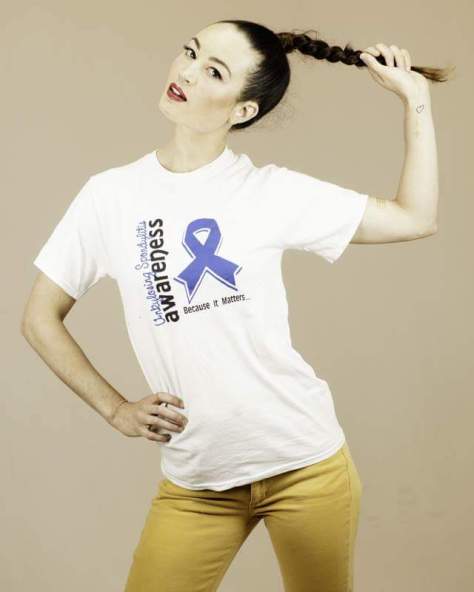
“I made this shirt.” Image by Rich Beckermeyer; Makeup by Alex Cassie
As if I hadn’t already made the most difficult decision of my life to accept my inability to work, applying for disability takes it one step further, forcing me to accept every single other thing I can no longer do, even those I am not ready to accept. I still have dreams of being healthy, so please don’t take what’s left away from me too.
My reality has been muted by the towering, sound-proof piles of paperwork that sprout legs and chase me while I toss and turn at night. I have to prove to the Social Security Administration that I am unable to work, but also that I can no longer function independently. I have to prove I no longer have a life despite all I have done to maintain a semblance of living. I feel I am on the middle school debate team and I’ve been assigned the side I don’t agree with; in order to win I have to admit that I am incapable of the freedoms I embraced in yesteryears. I have to do more than just admit them – I have to fully believe my inabilities enough to prove them true to strangers. I have to believe I’m less than I ever imagined I would be so that others will believe me too.
The piles of paperwork litter my kitchen table as I struggle to answer questions about my (in)ability to interact with people, go outside, take care of my health, and accomplish chores. Continue reading Applying for Disability Has Dehumanized Me→
Becoming disabled is indescribable, so of course here I am trying to write about it.
I did not simply become disabled and accept it with the snap of the fingers: “Aha, so that explains everything! I’m disabled!”
Let me make the clear distinction between becoming vs being disabled. Becoming disabled is a learning process. Being disabled is what happens after the shock has subsided and one has accepted disability as part of his or her identity. Plenty of people have never “become disabled” because they’ve always been disabled – they have never been any other way. The difference between becoming disabled and being disabled is as simple as broken versus whole. When we finally reach the acceptance stage, we are once again whole, having accepted that disability is part of us now.
There is no timeline to follow after a sudden and shocking diagnosis – other than scheduled doctor appointments, and perhaps the sudden tendency to plan for the unexpected worst so that if things improve there’s a reason to celebrate. Rather than having a reliable and predictable five-year plan, the sidewalk paves itself with each step you take.
It’s definitely not a walk in the park. Becoming disabled is more like walking through the apocalypse. Think broken pavement. Zombies. Car alarms. Birds, big black birds. And whatever else you can think of that you wouldn’t want to round the corner and run into. Clowns. Spiders. Snakes. Balloons. Door to door salespeople. Fear. That’s what I’m talking about. Fear. It’s what threatens to overtake each tentative step forward into the unknown, unpredictable new body you now inhabit. Fear is a powerful substance. Continue reading Becoming Disabled Is the Apocalypse→





 BeingCharis