Category Archives: ankylosing spondylitis

Ankylosing Spondylitis: Are We at a Tipping Point?

And I don’t just mean our bodies.


Recently, during a visit to the pharmacy, I noticed someone wearing the same compression gloves I was wearing.

“Hey, nice gloves!” I held up my hands to show mine.

She responded, “I have Raynaud’s.”

I said, “I have Ankylosing Spondylitis.”

…crickets. I might has well have just ripped off my clothes.

She looked as though I’d spoken another language. For a disease that is oh-so-NOT-rare, it sure feels like it in these instances. Not only is it a difficult pair of words to pronounce, people’s initial thoughts might revolve around names of dinosaurs – Ankylosaurus Spoondywhat?

Continue reading Ankylosing Spondylitis: Are We at a Tipping Point?

I Did Some Math to See if I Could Afford the American Health Care Act. Here’s What I Found.

Let’s say, just, you know, maybe, could be, hypothetically, I’m living under the Republican-proposed American Health Care Act.

And before I begin, I want to note that I did all of this without a preconceived notion of what the outcome would be. I chose pretty (really) conservative cost estimates to give the American Health Care Act the benefit of the doubt, and to see if, in a hypothetical situation, I would be able to afford the healthcare I need under the proposed system change.

Say I’m 30 (as I am) and, for this example, I’m still able to work. Let’s say I earn $30,000 per year. But it doesn’t matter what I make, because the “tax credit” is now based on age and not income (unless I make over a certain amount). So, as a 30 year old, I get a $2,500 per year tax credit to either A) put into an un-taxed health savings account, from where I can draw money to cover medical expenses, or B) go towards paying the premium of any plan I choose that is considered an “eligible individual health insurance policy” (for instance, I wouldn’t be able to use the tax credit for a plan that covered abortion). Let’s just go with option B for this experiment. Continue reading I Did Some Math to See if I Could Afford the American Health Care Act. Here’s What I Found.

The Dangers of Funding Medicaid with Block Grants; a Patient’s Perspective

When the Patient Protection and Affordable Care Act (AKA Obamacare) was written, the plan was for Medicaid expansion to provide health insurance for people who made too little to qualify for a subsidy to purchase a plan, but too much to qualify for Medicaid under the rules of the past. The goal was to create a system in which no one would fall into a so-called “coverage gap,” and poor people would have access to care regardless of their income.

It worked – for states that adopted the expansion.

A little-known hiccup (ok, heart attack) is that the Supreme Court declared Medicaid expansion optional for states, rather than mandatory. As of January 2017, 32 states have opted in to the expansion (including DC) and 19 states have not. In states that have not opted to expand Medicaid (because of politics) the coverage gap has caused many people to be unable to access affordable insurance or care. This New York Times Magazine article explores the struggles of some of these people: Life in Obamacare’s Dead Zone. However, in states that have opted into the expansion healthcare premiums have risen less sharply and more people are insured.

Case in point: me. I live with a debilitating disease called Ankylosing Spondylitis. I need specialized treatments and medications to slow its progression and prolong my life. Because I’m disabled and cannot work, I am poor, so I am one of over 14 million Californians and over 74 million Americans who receive Medicaid. It is my only option for healthcare. Continue reading The Dangers of Funding Medicaid with Block Grants; a Patient’s Perspective

A New Wheelchair User’s Experience at the Women’s March

The first time I used a wheelchair was after tearing my ACL during a college soccer match in Washington, D.C. in 2005. My teammates convinced me to use one when we visited the Holocaust Museum, instead of crutches. I remember feeling invisible. I remember being trapped in the middle of congested hallways and exhibit rooms, seeing nothing but the backs of people scooting around and in front of me like I was a planter box in their way. I remember feeling empathy for people who spend a majority of their lives in a wheelchair. I hardly remember anything about the museum from that visit. And I became terrified of ever needing to use a wheelchair again.


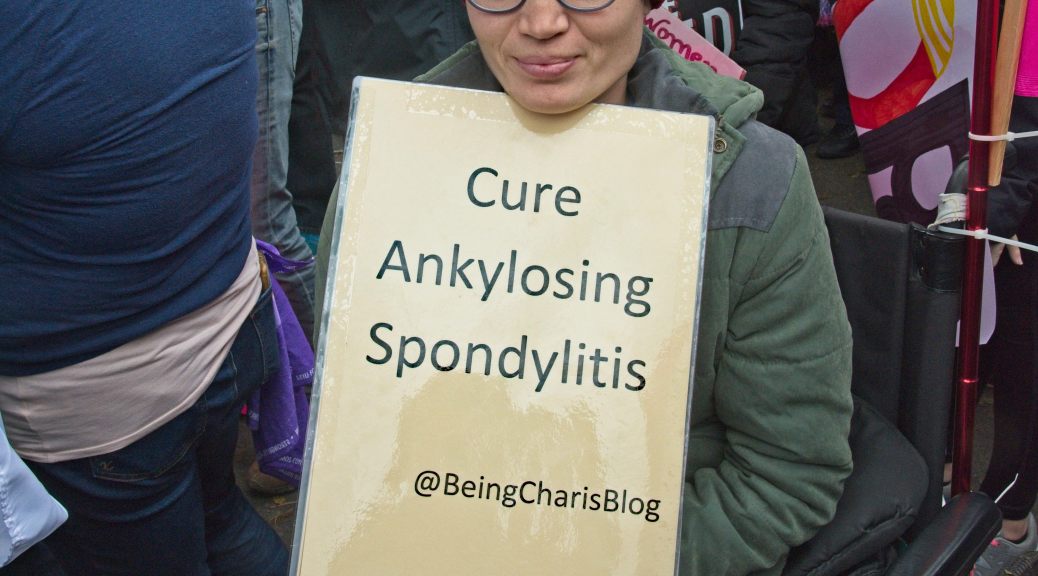
On January 21st, 2017, I rolled in the Women’s March on Sacramento alongside some 30,000 people. I have only recently, very reluctantly, decided to begin using a wheelchair because of deteriorating health. My experience from college still haunts me, but I am learning to embrace how much more fully I can participate in life by using assistive devices that reduce pain and fatigue caused by Ankylosing Spondylitis. It’s the difference between staying home and showing up.

However, I was nervous about navigating the march, even with friends to help push me. I expected that I would spend all my energy advocating for space just to be able to proceed in a straight line. I thought I might regret the decision to use the chair, even though not using it could result in being bedridden for days or weeks.

Would I return home wishing I had not gone? Continue reading A New Wheelchair User’s Experience at the Women’s March