
When Try Guys member Zach Kornfeld announced he has Ankylosing Spondylitis (AS) in September 2017 I was so relieved.
I know what you’re thinking. Relief sounds super self-centered, so let me say right now that I was also really sad for Zach’s diagnosis; I wouldn’t wish Ankylosing Spondylitis on my worst enemy. But when you live with a common-but-unknown disease, awareness is what you live for.
Well, it’s what I live for anyway. And when a celebrity makes an announcement a lot of people pay attention.
Zach’s video marked the second “Ankylosing Spondylitis coming out” by a celebrity figure in two years (Dan Reynolds announced his in 2015) and it made a big splash in the AS community. Spondylitis Twitter was buzzing. Spondylitis Facebook and Instagram were buzzing, etc etc. It was exciting to see someone talking frankly about AS to a really large audience (as of April 27, 2018 the video had nearly 4.9 million views). Zach was telling all our stories by telling his own and we clung to this moment as a chance to be seen and heard.
Here, let me lay this out for you better.
Ankylosing Spondylitis is an immune-mediated inflammatory disease that can progressively damage joints in the body, especially in the spine, and in some cases cause the spine to fuse into a column of rigid bone. Additionally, AS is a systemic, or whole-body, disease; so it can cause fatigue, cognitive impairment, sleep impairment, and damage multiple organs in the body. There is no cure, so the goal for treatment is to reduce inflammation to slow the progression of the disease and manage symptoms.
Many of us who have AS had never even heard of the disease before a doctor sat us down and opened their mouth to a flood of slow motion gibberish, “You have A n k y l o s a u r a s d i n o s a u r S p o o n d a c t y l a u r u s B l i b b i d y B l o p p i d y B o o.”
Then, as if our disease isn’t hard enough to pronounce, our own friends and family struggle to even understand what we’re experiencing and that it’s serious. And a lot of general practitioners have already forgotten the one paragraph about AS they read during medical school. There are even rheumatologists (the specialists who treat AS) who refuse to diagnose women. More about that another time.
And yet AS affects so many people. Ankylosing Spondylitis falls under an umbrella of diseases called Spondyloarthritis, which affects an estimated 2.7 million people in the USA alone. That’s more than Amyotrophic Lateral Sclerosis (ALS)/Lou Gherig’s Disease, Multiple Sclerosis, and Rheumatoid Arthritis combined. Estimates vary regarding the number of people specifically with AS in the US, but it is the most prevalent type of Spondyloarthritis. That’s a LOT of people.
There are more people with ankylosing spondylitis in the USA than there are Episcopalians.
Just, fyi.#spotspondy #spondywhat
— BeingCharis (@BeingCharisBlog) April 26, 2018
I wish nobody had AS, but since a lot of us do and we largely suffer in silence, Zach’s video was cause for celebration – not for his being diagnosed, but for his willingness to talk about it in front of millions of people.
When I saw his video I knew I wanted to help his story reach more people. I knew I wanted to talk to him.
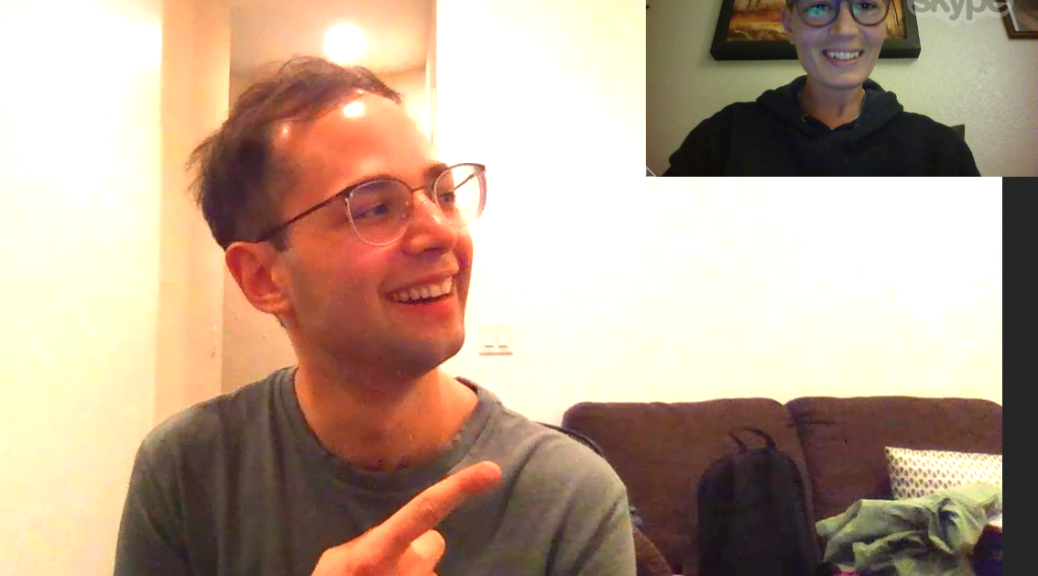
So six months later I reached out to him about a chronic disease documentary I’m in (shameless plug) and it turned into a Skype interview.
Continue reading I talked with Zach, the Try Guy with Ankylosing Spondylitis (part I)



 BeingCharis