Category Archives: chronic pain

An Open Letter to Congress from a Poor, Disabled American

Dear Congress,

My father died last September. He was 68. He experienced severe, debilitating pain from his early teenage years until his death. I now experience similar pain from the same disease he had, Ankylosing Spondylitis (AS), and I fear daily that my life will follow the same path his did.

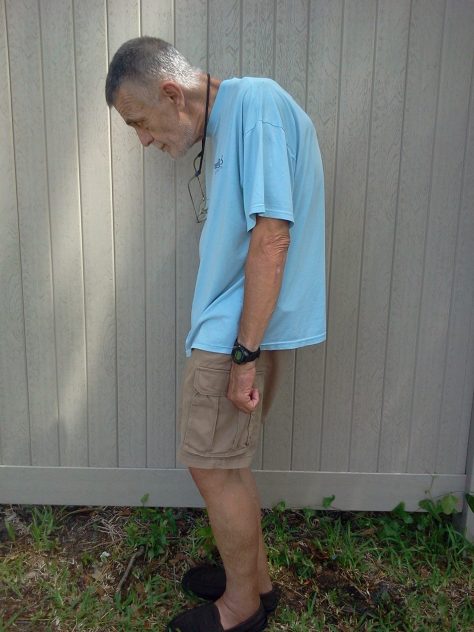
My dad looked like this (below) because he did not have access from a young age to effective treatments to slow down the progression of his disease:
17229909_10100211918071754_1683370465_o

He didn’t have access to the treatments because they didn’t exist until 2003, when the first biologic drug was approved for treating patients with AS. By that time he was already a 90-degree hunchback, his spine fused in a rigid column of bone from knobby, painful bone spurs – he was slowly suffocating. The only thing a biologic drug could do was prolong his life and perhaps reduce some of the symptoms.

He died after two surgeries meant to straighten his spine, relieve his organs from being crushed, and give him a more horizontal line of sight. He’d been looking straight down at the ground for decades, unable to see in front of him unless he pivoted his body backwards with one foot pushed toe-first into the ground.

I learned I had AS in 2013 after a period of sudden, un-treatable illnesses that left me in pain and unable to breathe. Urgent Care doctors blamed my frequent visits on panic attacks and attempted to send me on my way with anxiety medication, but I knew my body better than that. Continue reading An Open Letter to Congress from a Poor, Disabled American

Talking Ankylosing Spondylitis with Imagine Dragons’ Dan Reynolds

I don’t always interview rock stars – it’s not really my thing. But this day was different. This was personal.

It was a chilly morning, much too early for my stiff body to roll out of bed. But this was a big day – I would soon be interviewing Dan Reynolds, the lead singer of Imagine Dragons.

“This wouldn’t be happening,” I thought, “if we didn’t share a wicked diagnosis.”

In late 2015, Dan announced during a show that he lives with Ankylosing Spondylitis (AS). A year later, he partnered with Novartis Pharmaceuticals Corporation and the Spondylitis Association of America to launch This AS Life Live!, an interactive talk show for and by patients living with AS.

Before I keep going, I want to express how lonely it can be to trudge through life surviving a disease that people do not know about. I spend substantial time and energy educating friends, strangers, and even doctors about my condition, which leaves little room for receiving compassion and empathy – like the supportive gestures people usually offer to someone who has a disease in the limelight. Everyone knows cancer is bad, but AS is not a well-known disease, so for a celebrity to name it on stage is life-changing. Continue reading Talking Ankylosing Spondylitis with Imagine Dragons’ Dan Reynolds

14 Ways To Become a Chronic Disease Advocate

There is not a one-size-fits-all way to become a chronic disease advocate or activist. Everyone’s journey will be shaped by personal experiences, interests, time and ability.

I’ve gathered these tips from my own journey, but by no means is this an exhaustive list and I don’t recommend attempting them all at once. Also, while directed at people who have chronic diseases, these tips can apply to partners, caregivers, friends and family who want to become allied advocates.

As long as the end goal is to raise awareness publicly for the sake of social or political change, there is no inherently wrong way to create an advocacy platform.


1) Get comfortable telling your own story. Come out as sick. Introduce your disease to friends, family, and peers in a manner that also outlines your clear desire for them to listen – you may even need to say, “This is my story and unless you have lived it, I expect you to really hear me.” No one can tell your story for you and owning your experience can be empowering. Also consider that there are hundreds, thousands, or millions more people experiencing the same things you are.

dsc_7817
Charis giving a TEDx talk in Sacramento, CA in September 2016

Continue reading 14 Ways To Become a Chronic Disease Advocate

A New Wheelchair User’s Experience at the Women’s March

The first time I used a wheelchair was after tearing my ACL during a college soccer match in Washington, D.C. in 2005. My teammates convinced me to use one when we visited the Holocaust Museum, instead of crutches. I remember feeling invisible. I remember being trapped in the middle of congested hallways and exhibit rooms, seeing nothing but the backs of people scooting around and in front of me like I was a planter box in their way. I remember feeling empathy for people who spend a majority of their lives in a wheelchair. I hardly remember anything about the museum from that visit. And I became terrified of ever needing to use a wheelchair again.


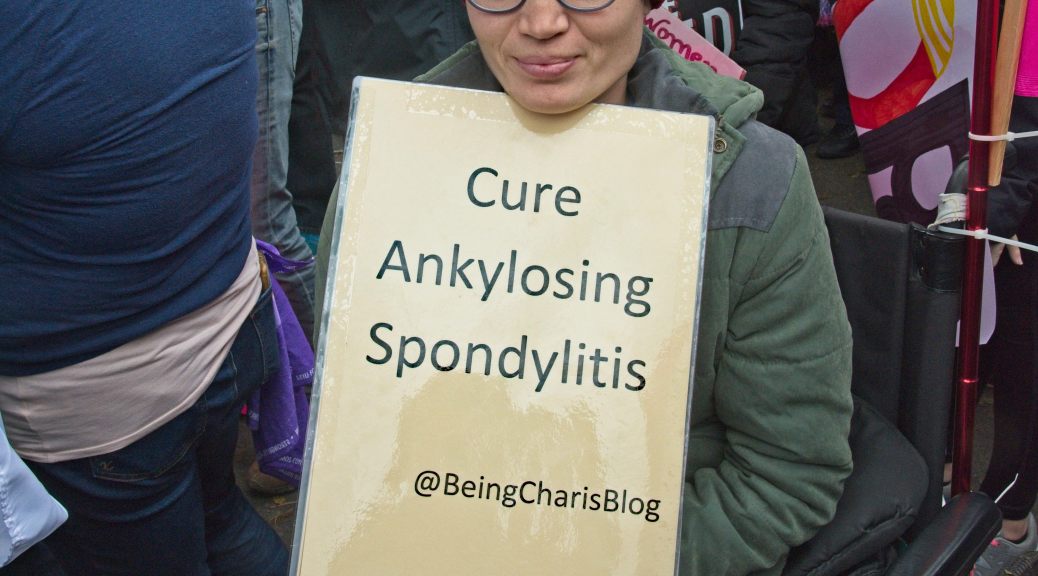
On January 21st, 2017, I rolled in the Women’s March on Sacramento alongside some 30,000 people. I have only recently, very reluctantly, decided to begin using a wheelchair because of deteriorating health. My experience from college still haunts me, but I am learning to embrace how much more fully I can participate in life by using assistive devices that reduce pain and fatigue caused by Ankylosing Spondylitis. It’s the difference between staying home and showing up.

However, I was nervous about navigating the march, even with friends to help push me. I expected that I would spend all my energy advocating for space just to be able to proceed in a straight line. I thought I might regret the decision to use the chair, even though not using it could result in being bedridden for days or weeks.

Would I return home wishing I had not gone? Continue reading A New Wheelchair User’s Experience at the Women’s March